
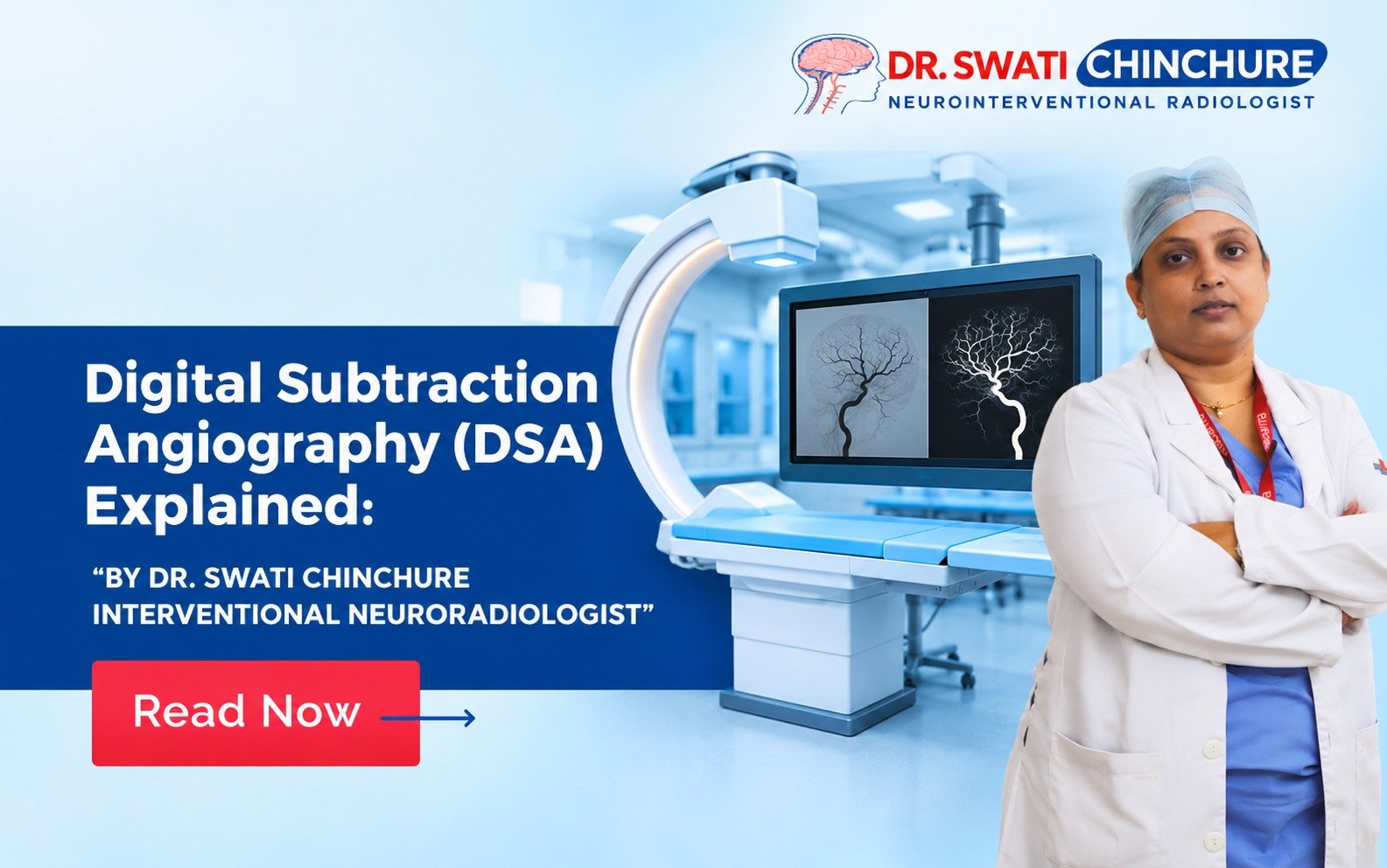
Neurosurgeon in Indore is one of the first searches families make when a CT or MRI scan shows a possible problem in the blood vessels of the brain. That is a natural reaction. Before any treatment decision, however, doctors often need a clearer picture, and this is where Digital Subtraction Angiography (DSA) helps. This guide explains the test in simple words and shows how an interventional neuroradiologist such as Dr. Swati Chinchure works alongside other brain doctors in Indore.
DSA is a special X-ray test that shows the arteries and veins of the brain in fine detail. Patients from Indore, Bhopal and nearby districts often need it when other scans leave questions unanswered. Understanding the test, and knowing which specialist does what, makes every decision easier.
What Is Digital Subtraction Angiography (DSA)?
DSA is an imaging test that takes live X-ray pictures of blood vessels after a contrast dye is injected. Contrast dye is a clear liquid that makes blood vessels show up on X-ray. The word “subtraction” refers to a computer step that removes bones and soft tissue from the picture, so only the vessels remain.
The result is a very sharp, moving image of blood flow. Doctors can see narrow spots, bulges, tangled vessels or blockages that other scans may miss.
Why Is It Called “Subtraction”?
The process works in four simple steps:
- The machine first takes an X-ray image before any dye is given. This is called the “mask.”
- Dye is then injected, and more images are taken.
- The computer subtracts the mask image from the dye images.
- Only the blood vessels stay visible, with a clear background.
Digital Subtraction Angiography in Indore: When Is DSA Needed?
Digital Subtraction Angiography in Indore is advised when doctors need exact details about the brain’s blood vessels. It is not a routine screening test. Your doctor suggests it for a clear medical reason.
Common reasons include:
- Bleeding around the brain, to find the source
- A suspected aneurysm (a weak, bulging spot on an artery wall)
- An arteriovenous malformation, or AVM (an abnormal tangle of vessels)
- Narrowing or blockage of arteries in the neck or brain
- A dural arteriovenous fistula (an abnormal connection between vessels)
- Rare vessel conditions such as moyamoya disease
- Planning surgery for a tumour with a rich blood supply
- Follow-up after coiling, stenting or surgery
Brain Aneurysm
An aneurysm can stay silent for years. If it bursts, it causes sudden, severe bleeding. DSA shows its exact size, shape and neck, which helps doctors choose between catheter treatment and open surgery.
Narrowed or Blocked Arteries
Fatty deposits can narrow the arteries that feed the brain. This raises the risk of stroke. DSA shows how tight the narrowing is and whether stenting or other treatment may help.
DSA Compared With CT and MR Angiography
Most patients start with a CT angiogram or an MR angiogram. Brain Angiography in Indore by DSA is chosen when those scans leave doubt or when treatment planning needs more detail.
| Feature | CT Angiography | MR Angiography | DSA |
| Method | Scan with dye through a vein | Scan, often without dye | Catheter and dye in an artery |
| Level of detail | Good | Good | Most detailed |
| use | Quick checks, emergencies | Screening, no radiation | Final answers and treatment planning |
| Can lead to treatment in the same session | No | No | Yes, in selected cases |
DSA Test in Indore: How to Prepare
A DSA Test in Indore needs some preparation. Your care team will give exact instructions for your case. These are the usual steps:
- Tell the doctor about allergies, especially to contrast dye, and about kidney disease, diabetes medicines or pregnancy.
- Do not stop blood thinners on your own. Your doctor will tell you what to do.
- Complete the blood tests, which often include kidney function and clotting tests.
- Avoid food and drink for the number of hours your team advises.
- Bring all earlier scans, reports and a list of your medicines.
- Arrange for a family member to stay with you.
What Happens During Brain Angiography in Indore?
Brain Angiography in Indore using DSA takes place in a special X-ray room called an angiography suite. Most patients stay awake with the skin numbed, and some receive light sedation.
The usual sequence is:
- You lie on the table, and the groin or wrist is cleaned and numbed.
- The doctor passes a thin tube (catheter) into an artery through a tiny puncture.
- X-ray guidance helps the doctor move the catheter to the neck arteries.
- Dye is injected. You may feel a brief warm flush, which passes quickly.
- Images are taken from several angles while you stay still.
- The catheter is removed, and the puncture site is closed with pressure or a closure device.
Many tests take about 30 to 60 minutes, although complex cases can take longer.
Recovery After DSA
You will rest flat for a few hours while the team checks the puncture site. Drink plenty of fluids to help clear the dye. Avoid heavy lifting for a day or two, or as advised.
Contact your doctor at once if you notice:
- Swelling, bleeding or a growing lump at the puncture site
- Severe pain or numbness in the limb
- Sudden weakness, trouble speaking or vision changes
Is DSA Safe?
DSA is generally safe when a trained team performs it. Most side effects are minor, such as bruising at the puncture site. Less common risks include an allergic reaction to the dye, strain on the kidneys, and, rarely, stroke or injury to a vessel.
Radiation exposure is kept as low as reasonably possible. Your doctor weighs these risks against the benefit of an accurate diagnosis, and you should feel free to ask questions before consenting.
Brain Specialist in Indore: Who Does What?
Medical titles can feel confusing. A brain specialist in Indore may be a neurologist, a neurosurgeon or an interventional neuroradiologist. Each has a different role, and they often work as one team. A neurosurgeon in Indore handles surgery, while a neurologist manages most treatment with medicines.
| Specialist | Main role |
| Neurologist | Diagnoses and treats brain and nerve diseases, mostly with medicines. Common areas include stroke, epilepsy and headache. |
| Neurosurgeon | Performs open surgery on the brain, spine and nerves, such as tumour removal or aneurysm clipping. |
| Interventional neuroradiologist | Uses imaging and catheters to diagnose and treat blood vessel problems without large incisions. |
Interventional Neurologist in Indore or Interventional Neuroradiologist?
People often search for an interventional neurologist in Indore when they want a doctor who treats stroke or aneurysm through a catheter. Training routes differ. Some doctors start as neurologists, while others start as radiologists and then train in neuroradiology.
What matters most is formal training in neurointervention, experience with your condition, and a well-equipped team. Dr. Swati Chinchure is an interventional neuroradiologist, so her training centres on reading vessel images and treating vessel disease through catheters.
Neuro Surgery Doctor in Indore: When Is Surgery Needed?
A neuro surgery doctor in Indore, also called a neurosurgeon, operates when a problem needs open surgery. Examples include certain aneurysms, brain tumours and head injuries. Many vessel problems can instead be treated through a catheter.
The choice between the two is rarely made by one person alone. DSA images help a neurosurgeon in Pipliyahana Indore and the neurointerventional doctor decide together.
Brain and Spine Specialist in Indore
The brain and the spine share the same nervous system, so a brain and spine specialist in Indore often treats problems in both. Neurosurgeons and neurologists commonly fill this role. DSA can also study blood vessels around the spine in selected patients, for example when a spinal vessel abnormality is suspected.
Neurointervention Specialist in Indore: Dr. Swati Chinchure
A neurointervention specialist in Indore uses thin catheters and X-ray guidance to diagnose and treat problems inside blood vessels of the brain, neck and spine. This approach can avoid large cuts and, in suitable cases, shortens recovery. Patients sometimes call this doctor an interventional neurologist in Indore, though the exact title depends on the doctor’s training.
Dr. Swati Chinchure is an interventional neuroradiologist based in Indore.
Her publicly listed qualifications are:
- MBBS
- DMRD (Diploma in Medical Radiodiagnosis)
- DNB in Radiodiagnosis
- DM in Neuroradiology, from Sree Chitra Tirunal Institute for Medical Sciences and Technology, Trivandrum
How to Choose the Neurosurgeon in Indore
No official ranking decides who the neurosurgeon in Indore is. The right doctor is the one whose training and experience match your condition. These checks help you decide:
- Right specialty. Confirm that the doctor treats your exact problem, such as a vessel disease, a tumour or a spine disorder. For spine problems, a brain and spine specialist in Indore is often the right starting point.
- Formal qualifications. A neuro surgery doctor in Indore should usually hold an MCh or DNB in Neurosurgery. Check registration with the medical council.
- Experience with your condition. Ask how often the doctor treats cases like yours.
- Team and facilities. Look for an angiography suite, a neuro ICU and round-the-clock emergency support.
- Clear communication. A good doctor explains options, risks and alternatives in plain words.
- Willingness to share opinions. Seeking a second opinion is normal and sensible.
Be cautious about anyone who guarantees results. Honest doctors talk about benefits and risks together. A good neurosurgeon in Indore will welcome your questions and a second opinion.
Why Experience Matters When Choosing the Neurosurgeon in Indore
Brain vessel problems demand sound judgement as much as technical skill. Experience helps a doctor read subtle details on a DSA image, choose between coiling, stenting and surgery, and handle complications calmly.
That is why the neurosurgeon in Indore for your case is rarely working alone. Strong results usually come from teamwork between a neurosurgeon in Indore, a neurologist and an interventional neuroradiologist. Dr. Swati Chinchure’s neuroradiology training supports her work as a neurointervention specialist in Indore, because accurate vessel imaging guides every later decision.
Brain Stroke Doctor in Indore: When to Seek Help Urgently
A stroke is a medical emergency. Every minute counts, so go to the nearest hospital with stroke care instead of waiting for a clinic appointment. Call 112 or 108 for an ambulance.
Remember the BE-FAST signs:
- Balance loss or sudden dizziness
- Eyes: sudden vision loss or double vision
- Face drooping on one side
- Arm or leg weakness
- Speech that is slurred or confused
- Time: act immediately
A brain stroke doctor in Indore may be a neurologist, a neurointerventional doctor or a neurosurgeon, depending on the cause. In selected patients treated early enough, a catheter can remove the clot (mechanical thrombectomy). A sudden, severe headache that feels unlike any before is also an emergency, since it can signal a burst aneurysm.
When to Book a Planned Consultation
Book a consultation soon, though not as an emergency, if:
- A scan report mentions an aneurysm, AVM or narrowed artery
- You had a brief episode of weakness or speech trouble that cleared (contact a brain stroke doctor in Indore at once, as this can warn of a stroke)
- Your doctor has advised DSA and you want to understand the procedure
- You need a second opinion on a treatment plan, or want to compare options before choosing the neurosurgeon in Indore
What to Expect at Your Consultation
A first visit with a brain specialist in Indore, such as Dr. Swati Chinchure, an interventional neuroradiologist, usually follows this path:
- History and examination. The doctor asks about symptoms, past illness and medicines.
- Review of scans. Bring your CT, MRI and reports.
- Explanation. You learn whether DSA is needed and why.
- Consent and risks. The doctor explains benefits, risks and alternatives.
- Plan and follow-up. You leave with clear next steps.
Whichever doctor you consider the neurosurgeon in Indore, expect honest answers and a clear plan.
Frequently Asked Questions About the Neurosurgeon in Indore and DSA
1. What is Digital Subtraction Angiography in Indore?
Digital Subtraction Angiography in Indore is a catheter-based X-ray test that shows brain blood vessels in fine detail. A computer removes bones from the image, so only the vessels remain. Doctors use it to find aneurysms, blockages and abnormal vessels.
2. Is the DSA Test in Indore painful?
The DSA Test in Indore is generally not painful. The puncture site is numbed, so you feel pressure rather than pain. You may notice a warm flush when the dye goes in.
3. How long does Brain Angiography in Indore take?
Brain Angiography in Indore often takes about 30 to 60 minutes. Complex cases take longer. You will then rest for a few hours so the puncture site can heal.
4. Who is the neurosurgeon in Indore for a brain aneurysm?
No single doctor is the neurosurgeon in Indore for every aneurysm. The right choice depends on the aneurysm’s size, shape and location, and on your health. A joint review by a neurosurgeon and an interventional neuroradiologist, using DSA images, helps pick the safest treatment.
5. When should I see a brain specialist in Indore?
See a brain specialist in Indore if you have repeated severe headaches, seizures, weakness, speech trouble or an abnormal scan report. Go to an emergency department at once for stroke signs or a sudden, severe headache.
6. What does a neurointervention specialist in Indore do?
A neurointervention specialist in Indore diagnoses and treats vessel diseases of the brain, neck and spine through catheters. Examples are DSA, aneurysm coiling, stenting and clot removal in stroke. This usually means smaller wounds than open surgery. Dr. Swati Chinchure works in this field as an interventional neuroradiologist.
7. Is an interventional neurologist in Indore different from an interventional neuroradiologist?
An interventional neurologist in Indore usually trained first as a neurologist, while an interventional neuroradiologist trained first in radiology. Both can perform catheter procedures after specialised training. Dr. Swati Chinchure is an interventional neuroradiologist.
8. Which brain stroke doctor in Indore should I contact in an emergency?
In an emergency, do not search for one doctor. Call 112 or 108 and reach the nearest hospital with stroke care. That hospital’s brain stroke doctor in Indore and the neuro team will assess you quickly.
9. When is a neuro surgery doctor in Indore needed after DSA?
A neuro surgery doctor in Indore is needed when DSA shows a problem that is better treated by open surgery, such as certain aneurysms or tumours. If a catheter can treat it safely, surgery may not be needed. The treating team explains the reasoning, and a neurosurgeon in Indore can tell you whether surgery is truly required.
10. Can a brain and spine specialist in Indore use DSA for spine problems?
A brain and spine specialist in Indore can request DSA for the spine’s blood vessels when an abnormality such as a spinal vessel malformation is suspected. It is done only for a clear medical reason. Most spine problems need other tests, such as MRI.
11. Can patients from Bhopal get Digital Subtraction Angiography in Indore?
Yes. Many patients travel from Bhopal and other cities for a DSA Test in Indore, since advanced neuro procedures are available in only some centres. Plan to stay for a day or two, carry all reports and ask the team about the schedule before travelling.
Conclusion: Finding the Neurosurgeon in Indore Starts With a Clear Diagnosis
Finding the neurosurgeon in Indore begins with understanding your diagnosis. DSA gives that clarity for diseases of the brain’s blood vessels, and it guides whether you need catheter treatment, surgery or only monitoring. Whether you live in Indore or travel from Bhopal, choose a team that explains each step honestly.
If you have been advised to undergo DSA, or you want an expert opinion on your scans, consider a consultation with Dr. Swati Chinchure, Interventional Neuroradiologist in Indore. Bring your reports, ask your questions, and make decisions with full information.